Trained homing birds
Use only healthy white homing pigeons trained to return to an established loft — never non-homing doves bought simply to be set free.

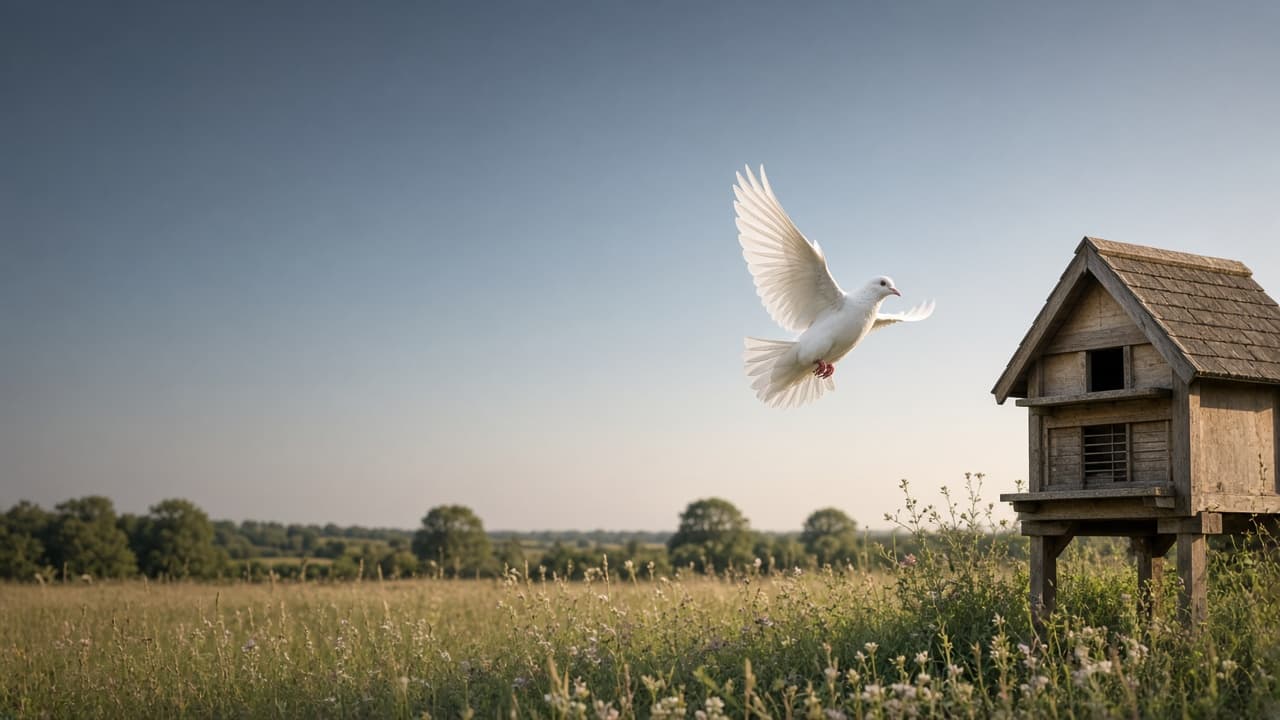
A symbolic farewell
A ceremonial bird release can hold powerful meaning, but the birds' welfare comes first. Safe planning needs a trained specialist, suitable conditions and an alternative ready.
What a release involves
The “doves” used by responsible ceremonial providers are normally white homing pigeons. They are conditioned to navigate back to a particular loft after the release.
That distinction is essential. A bird without homing ability may become lost, struggle to survive or be injured by predators. A release should never involve buying an untrained bird and letting it go.
Your celebrant can help place the moment naturally within the ceremony, but the birds and the decision to fly them must remain with an experienced specialist provider.
Before you book
Use only healthy white homing pigeons trained to return to an established loft — never non-homing doves bought simply to be set free.
The specialist should explain their birds’ training, safe travel distance, handling, return arrangements and cancellation policy clearly.
Weather, visibility, daylight and time needed to fly home all matter. A responsible provider must be willing to cancel on the day.
The provider should confirm venue permission and check the latest animal-health rules and any local disease-control restrictions.
Rules can change in response to avian disease. Providers should consult the latest official bird-gathering guidance for England on GOV.UK and the relevant devolved authority for the date and location of the ceremony.
A closer look
Families often choose a dove release to honour and celebrate a life in a serene, meaningful way — a moment that can symbolise hope, freedom, peace, serenity and a sense of new beginning for the departing spirit.
The strongest releases are gentle rather than theatrical: a few carefully chosen words, a pause, and then the birds take flight. Your celebrant can help shape that moment so it feels true to the person and comfortable for those watching.
A reading often chosen
Traditionally circulated as anonymous. If you prefer a different poem, your celebrant can help you choose one that fits the person and the tone of the day.
Anonymous
When I am gone, release me, let me go.
I have so many things to see and do.
You must not tie yourself to me with tears.
Be happy that I have had so many years.
I gave you my love; you can only guess
how much you gave me in happiness.
I thank you for the love each have shown,
but now it is time I travelled on alone.
So grieve a while for me, if grieve you must,
then let your grief be comforted by trust.
It is only for a while that we must part,
so bless the memories in your heart.
I will not be far away, for life goes on.
So if you need me, call and I will come.
Though you cannot see or touch me, I will be near.
And if you listen with your heart, you will hear
all of my love around you soft and clear.
Then, when you must come this way alone,
I will greet you with a smile and a “Welcome Home.”
Building the moment
Decide what the moment represents for your family — release, return, peace, freedom or simply a shared pause.
Your celebrant and venue can coordinate timing, while the bird provider remains responsible for welfare and whether conditions are safe.
Write the ceremony so it still feels complete if the birds cannot fly. A cancellation should never place pressure on the provider.
No live birds
Invite each person to place a flower beside a photograph or into a shared arrangement to take home afterwards.
Create a quiet shared moment indoors or use venue-approved LED candles where flames are not permitted.
A tree, rose or small collection of bulbs can become a place to return to as the seasons change.
Ask guests to write one story or sentence, then gather the cards into a keepsake for the family.
Common questions
Reputable release providers generally use white homing pigeons, which are part of the dove and pigeon family and are trained to navigate back to their loft. Ringneck doves and other non-homing birds should not be released.
Yes — and it should be if conditions are unsafe. Poor visibility, strong wind, heavy rain, extreme temperatures or too little daylight can prevent birds returning safely. The specialist provider must make the final welfare decision.
Check with the cemetery, crematorium, venue or landowner before booking. The specialist provider should also check current animal-health requirements and disease-control zones for the location and date.
Your celebrant can lead the same words and symbolic pause without live birds, or move to a planned alternative such as flowers, candles or memory cards. The meaning of the moment does not depend on a release taking place.
Begin with the meaning, then plan safely.
A celebrant can help shape the words and coordinate the ceremony.